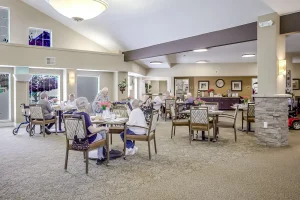
Families rarely know what to expect. Most have never spent a full day inside a senior living community. That gap between imagination and reality often causes the most worry.
This walkthrough answers a simple question honestly: what does a resident’s day actually look like? No brochure language. Just a clear, hour-by-hour picture.

Why This Question Matters So Much
Adult children carry a quiet fear. They worry a parent will sit alone, bored, forgotten. That fear often comes from not knowing, not from anything real.
A typical day in assisted living is usually far fuller than people expect. It often includes movement, meals, company, and quiet time, all built around the resident.
7:00 to 9:00 AM: Mornings Start on the Resident’s Terms
Mornings typically begin whenever a resident chooses to wake. There is often no set alarm, no rush, no single schedule for everyone.
A caregiver may check in to help with dressing or medication reminders. Many residents prefer to manage this part of the morning themselves.
Breakfast is usually served restaurant-style, with choices and flexible timing. Some residents eat in the dining room. Others prefer a quiet tray in their apartment.

9:00 to 11:00 AM: Movement and Wellness
Late morning often brings light exercise, stretching, or a walking group. These sessions are typically gentle and adapted to each resident’s ability.
This time slot commonly includes wellness checks, physical therapy, or a visiting nurse. Nothing is forced. Participation is almost always the resident’s choice.
11:00 AM to 1:00 PM: Lunch and Connection
Lunch is often the social heart of the day. Residents typically sit with familiar faces and catch up on the morning.
Staff frequently join tables briefly, not to supervise, but to visit. These small exchanges often matter more to residents than any planned activity.
1:00 to 3:00 PM: Rest and Personal Time
Afternoons commonly slow down. Many residents nap, read, or call family.
This window is rarely programmed on purpose. Independence and downtime are typically treated as part of a healthy day, not a gap in care.
3:00 to 5:00 PM: Afternoon Programming
This is often the most active stretch of the day. Activities can include art, music, trivia, gardening, or a small outing.
Programming is typically designed with real choice in mind. A resident can join a group activity or spend the hour with a hobby instead.
Common afternoon offerings often include:
- Art or craft sessions
- Music therapy or a sing-along
- Card games and trivia
- Light gardening or courtyard time
- Visits from family, volunteers, or therapy animals
5:00 to 7:00 PM: Dinner and Evening Wind-Down
Dinner typically mirrors lunch in warmth, but the pace usually slows. Evenings often bring a calmer version of the same social rhythm.
After dinner, many communities host a low-key activity, like a movie or live music. Others simply give residents space to relax.

7:00 to 9:00 PM: Quiet Hours Begin
Evenings are usually unhurried. Lights dim gradually, and hallways grow quiet. Staff remain visible, but present themselves gently, not intrusively.
Medication reminders, if needed, often happen during this window.
Overnight: Safety Without Feeling Watched
Overnight staff typically remain on-site around the clock. Check-ins are usually discreet, designed to reassure rather than disrupt sleep.
This is often the detail families care about most. Help is typically close by, even at 3 a.m., without a resident ever feeling monitored.
Why a Predictable Routine Actually Helps
A steady daily rhythm is not just convenient. It often supports real health outcomes. According to the National Institute on Aging, older adults who stay socially and physically engaged are less likely to develop certain health problems and often report a longer, more satisfying life.
This is one reason structured, flexible days matter so much in senior living. Routine paired with choice tends to support both body and mood.
Falls are also a daily safety consideration in any senior community. The CDC reports that more than one in four older adults falls each year, which is why movement, supervision, and home design are built into the daily schedule, not treated as an afterthought.
What Makes a Day Feel Like Home at Mission Senior Living
Every Mission Senior Living community operates under one framework: Caring People. Serving People. Improving Lives. This is not a slogan. It shapes how staff are trained, hired, and supported every day.
Team members are trained to notice small moments, not just complete tasks. That training is part of why residents often describe their day as full, not managed.
Programs like MVP in Action give team members the ability to create unplanned moments of joy. A favorite meal. A surprise visit. A small gesture that turns an ordinary afternoon into a good day.
These are the details a brochure cannot capture. They typically show up only once you see a real day in motion.
Questions to Ask During a Tour
A tour is the best way to confirm what a typical day really looks like. Try asking:
- What does the schedule look like on a normal Tuesday?
- Can my parent skip an activity without pressure?
- How are overnight check-ins handled?
- How do staff members get to know residents personally?
- What happens if care needs change over time?
See a Real Day for Yourself
The best way to understand a typical day is to walk through one in person. We would love to show you around and answer every question, big or small.
Schedule a tour with your nearest Mission Senior Living community today.
This article is for general informational purposes only and is not a substitute for professional medical, legal, or clinical advice. Please consult a physician or qualified healthcare provider with any questions about a specific health condition or care need.